
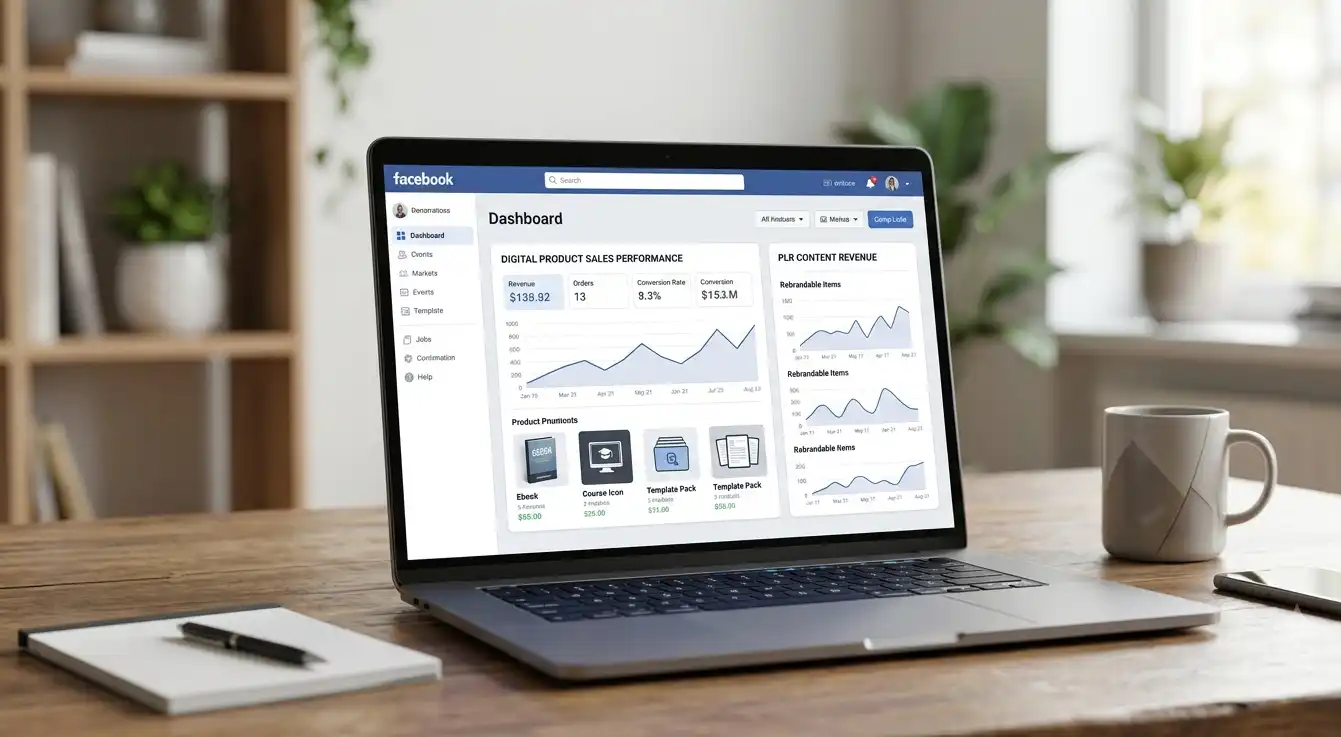
Digital products are one of the best things you can sell online. There’s no inventory, no shipping, and you can sell the same file a thousand times. PLR (Private Label Rights) content takes that even further — you buy ready-made content once, rebrand it as your own, and sell it for profit.
The hard part isn’t the product. It’s getting it in front of buyers. And that’s exactly where Facebook comes in. With billions of active users and powerful local and interest-based targeting, Facebook is still one of the most effective places to sell digital products — if you do it the right way.
This guide walks you through the whole process: setting up your page, posting content that actually converts, running ads, and boosting engagement so your posts get seen — all without coming across as spammy.
Why Facebook Works for Selling Digital Products and PLR
Selling a digital product is a trust transaction. Nobody buys an ebook, course, template pack, or PLR bundle from a stranger they don’t believe in. Facebook is built to create that trust at scale.
Here’s why it’s such a strong channel:
- Massive, targeted reach. You can put your offer in front of people by interest, behavior, and location — the exact audience most likely to buy.
- It’s built for warm-up. People rarely buy on the first touch. Facebook lets you educate, entertain, and build familiarity until they’re ready.
- Low cost to start. You can grow organically for free, then add a small ad budget once something is working.
- Direct path to the sale. A post or ad can lead straight to a checkout page, a lead magnet, or a Messenger conversation.
The marketers who win on Facebook aren’t the ones blasting “Buy now!” all day. They’re the ones who give value first and sell second.
Step 1: Set Up Your Foundation
Before you promote anything, your setup needs to be solid — because every post and ad sends people somewhere, and a weak destination leaks sales.
Create a dedicated Facebook Page (not just a personal profile) for your brand. Fill it out completely: a clear profile photo or logo, a banner that states what you offer, an “About” section that explains who you help, and a working link to your store, blog, or lead magnet.
Set your primary call-to-action button to match your goal — “Shop Now,” “Sign Up,” or “Send Message.”
Plan your link strategy. Facebook tends to limit reach on posts with external links in the main text, so a common workaround is to put the link in the first comment, or use a simple “comment ‘YES’ and I’ll send it to you” approach that drives engagement and starts conversations.
Build a lead magnet. Most people won’t buy on day one, so give away something valuable for free (a checklist, a sample, a mini-guide) in exchange for an email. That email list becomes your most reliable sales channel over time.
Step 2: Understand What Makes PLR Worth Selling
If you’re new to PLR, here’s the short version: Private Label Rights content is pre-made content — ebooks, articles, courses, graphics, printables, videos — that you’re licensed to edit, rebrand, and sell as your own. It lets you launch a digital product business without creating everything from scratch.
The key to selling PLR successfully is not selling it raw. Buyers can tell when content is generic. The winners customize it: they add their voice, update it, redesign the cover, bundle pieces together, and position it for a specific audience.
If you want to go deeper on choosing quality PLR and avoiding low-grade junk, resource sites like Internet Marketing Mozie (immozie.com) publish detailed PLR reviews, membership comparisons, and tutorials on how to repurpose PLR into profitable products. It’s a useful place to start when you’re sourcing content you’ll actually be proud to sell.
Step 3: Build an Audience Before You Sell
This is the step most people skip — and it’s why their “buy my product” posts fall flat. Selling to people who don’t know you yet is hard. Warming them up first makes everything easier.
Aim for an 80/20 content mix: roughly 80% free value and connection, and only 20% direct selling. Rotate through a few content pillars:
- Educate — quick tips, how-tos, mini-tutorials related to your product’s topic.
- Inspire — results, transformations, before-and-after stories.
- Engage — questions, polls, “this or that,” relatable struggles.
- Show proof — testimonials, screenshots, reviews, case studies.
- Sell — a clear, confident offer with a single next step.
When you consistently give value, your audience starts to see you as the go-to person in your niche. Then when you do make an offer, it lands.
Step 4: Post Content That Sells (Without Being Spammy)
The feed rewards content that keeps people on Facebook and sparks interaction. Here are post types that consistently drive engagement and sales for digital products and PLR:
- The “quick win” tip. Teach one small, useful thing in a single post. It builds authority and gets saves and shares.
- The myth-buster. “You don’t need 10,000 followers to sell digital products. Here’s why.” Contrarian takes spark comments.
- Behind-the-scenes. Show how you build, customize, or package a product. People love process.
- The mini case study. “Here’s how I turned one PLR pack into three products.” Story sells.
- The carousel. Break a topic into swipeable slides — carousels boost watch-time and reach.
- Short video / reel. A 30–60 second talking-head or screen-share video gets prioritized in the feed.
- The poll or question. “What’s your biggest struggle with selling online?” Low effort to answer = high engagement, and great market research.
- The soft offer. “Just finished a new template pack — comment ‘INFO’ if you want the link.” Drives engagement and starts sales conversations.
Make your captions easy to read: a strong first line (the hook), short paragraphs, and a clear call-to-action at the end.
Step 5: Boost Engagement on Your Posts and Ads
Engagement is the fuel that gets your content shown to more people. A few practical ways to lift it:
- Lead with a hook. The first line decides whether someone stops scrolling. Use curiosity, a bold claim, or a relatable pain point.
- Ask for interaction. End posts with a question or a one-word comment prompt.
- Reply to every comment fast. Early engagement tells the algorithm your post is worth showing. Replying also restarts conversations.
- Use native content. Upload videos and images directly to Facebook instead of linking out — native content gets more reach.
- Post when your audience is active. Check your Page Insights and post around peak times (often evenings and weekends).
There are also plenty of AI tools now that help with hooks, captions, scheduling, and graphics. If you want to find ones that are actually worth using, immozie.com reviews a wide range of AI social media and content tools so you can shortcut the trial-and-error.
Step 6: Run Facebook Ads for Your Digital Products
Once a post or offer is working organically, ads let you scale it. You don’t need a big budget — digital products have high margins, so even modest spend can be profitable.
- Boost your best content. If an organic post performed well, putting money behind it is low-risk.
- Target by interest and behavior. Reach people who follow related pages, topics, or competitors in your niche.
- Use lead ads. Collect emails directly inside Facebook for your lead magnet, then sell through email follow-up.
- Retarget warm audiences. Show your offer to people who watched your video, visited your page, or engaged with a post — they convert far better than cold traffic.
- Track what matters. Measure clicks, leads, and sales — not just likes.
A simple, reliable funnel looks like this: engaging content → free lead magnet → email list → paid offer. Ads can feed every stage of it.
Step 7: Turn Engagement Into Sales
Likes and comments don’t pay the bills — conversions do. Build a clear bridge from attention to purchase:
- Capture the email. Always have a free offer that turns a follower into a subscriber you can reach again.
- Use Messenger. When someone comments “INFO” or “YES,” follow up in Messenger with a friendly, helpful message and the link.
- Make checkout effortless. Send people to a clean, fast sales or checkout page with no distractions.
- Follow up. Most sales happen after several touches. Email sequences and retargeting ads do the quiet work of closing.
Staying Compliant and Trustworthy
A few rules keep your account safe and your reputation intact:
- Disclose affiliate links. If you earn a commission, say so. It’s required by Facebook’s policies and FTC-style disclosure norms — and it builds trust.
- Avoid exaggerated income claims. Don’t promise guaranteed riches; Facebook restricts “get rich quick” messaging and it erodes credibility.
- Respect PLR licenses. Always check what each PLR license allows (some forbid giving content away or reselling rights), and follow it.
- Keep it honest. Sell products you’d actually recommend. Long-term trust beats a one-time sale every time.
Common Mistakes to Avoid
- Selling constantly with no free value in between.
- Posting external links in the main caption and tanking your reach.
- Selling raw, un-customized PLR that looks generic.
- Ignoring comments and messages, or replying too slowly.
- Running ads to cold audiences with no lead magnet or follow-up.
- Measuring success by likes instead of leads and sales.
The Bottom Line
Facebook is one of the best places to sell digital products and PLR content — but only when you treat it as a trust-building platform, not a billboard. Set up a solid page, give value far more often than you sell, post content that sparks engagement, capture emails with a lead magnet, and put a small ad budget behind what’s already working.
Do that consistently and your Facebook presence stops being a place where you hope to sell, and becomes a system that reliably turns followers into buyers.
If you’re sourcing quality PLR or looking for tool and software reviews to support your digital product business, Internet Marketing Mozie is a solid resource to bookmark as you build.
Found this helpful? Share it with someone building an online business — and drop a comment with the digital product you’re working on.
You Might Also Like
7 Facebook Post Ideas That Actually Make People Comment
Turning Product Posts Into Comment Magnets: Lessons for Fashion & Leather Brands

Facebook Marketing for DJs, Photo Booths, and Event Pros

Facebook Marketing for Dentists: How Dentists Can Turn Facebook Into a Patient Pipeline

Boost Engagement: Buy Custom Facebook Comments in 2026
The Ultimate Guide to Buying Facebook Comment Replies in 2026: Ethical Strategies for Boosting Engagement
Supercharge Your Facebook Photos: Why Emoji Comments Are Your Secret Weapon for Engagement
Scaling Your Facebook Presence in 2026: A Guide to Reel Engagement

Why Do Experts Emphasize the Companies to Buy Real Active Facebook Comments?
Key Business and Marketing Reasons to Buy Real FB Comments
Key Reasons for Companies to Prioritize Facebook Engagement in 2026
Maximize Your Business Growth: The Strategic Advantage of Facebook Comments

Friendly and Convenient Directions for Customers to Buy Active Facebook Comments
The Strategic Guide: When and Why to Buy Real Facebook Comments for Business Growth
Sharing Informative Content through Facebook Comments