

Buying Facebook reactions is safe when the reactions come from real profiles, arrive gradually, and never require your password. The risk isn’t in the idea — it’s entirely in how a provider delivers. Instant dumps of bot reactions can get stripped off and, in the worst case, flag your Page. A believable drip from established accounts looks like a post catching on, because that’s effectively what it is. Here’s how to tell the difference.
- What Facebook enforces against is inauthentic behaviour — fake accounts, automation, coordinated spam — not “a post got more reactions than usual.”
- Safe pattern: real accounts, drip delivery over hours, no login access, a refill guarantee, and a believable ratio to comments.
- Red flags: instant delivery, prices that are too good, any request for your password, or huge numbers on a tiny Page.
- The safest version pairs a small seed with content that can actually earn reactions on its own.
The short answer
For a normal business or creator Page, buying a modest number of reactions from real profiles — drip-fed and timed to a fresh post — does not put your account at risk. Facebook isn’t scanning for “this post outperformed,” it’s scanning for the fingerprints of fake activity. Avoid those fingerprints and you avoid the problem.
What Facebook actually enforces against
Facebook’s policies target inauthentic engagement: networks of fake accounts, bots and scripts, and coordinated schemes that manipulate distribution. Enforcement mostly hits the accounts doing the fake activity, and secondarily the content that clearly benefited from a bot network. What it does not do is penalise a Page because one post got 120 reactions instead of its usual 15.
So the question isn’t “is buying reactions against the rules” in the abstract — it’s “does this delivery look like a bot network or like real people.”
What “safe” looks like
A low-risk reaction order has all of these: real, established profiles (history, friends, their own activity) · gradual delivery over several hours, not seconds · no password or login — everything works from the public post URL · a refill guarantee if any drop off · a sane quantity for your Page size · a believable ratio — a few comments alongside a big reaction order.
That is exactly how our reactions service is built, and the full walkthrough is in the practical guide to buying Facebook reactions.
What “unsafe” looks like
- Instant delivery. 500 reactions in two minutes is the single clearest bot signature.
- Any request for your password, a login code, or “admin access” to your Page. Never do this — it’s an account-takeover risk regardless of the reactions.
- Empty or generic accounts — no photo, no friends, no posts. These get purged in spam sweeps and take your reaction count with them.
- Wildly off-scale numbers — 10,000 reactions on a Page with 300 followers looks bought to a human, let alone an algorithm.
- Prices that don’t add up. Real profiles cost real money; rock-bottom pricing means bots.
Does buying reactions get Pages banned?
Buying reactions from real profiles at a natural pace, in sensible quantities, does not get Pages banned — there’s nothing there for enforcement to catch. The cases where people do get burned almost always involve one of the red flags above: a bot service, or handing over login details to a sketchy seller. Bans that follow are usually about the account access, not the reactions.
If you want zero ambiguity: keep orders modest, drip-fed, from real accounts, and treat bought reactions as a nudge for posts that could realistically earn that engagement anyway — not as a way to fake a viral hit.
How we do it
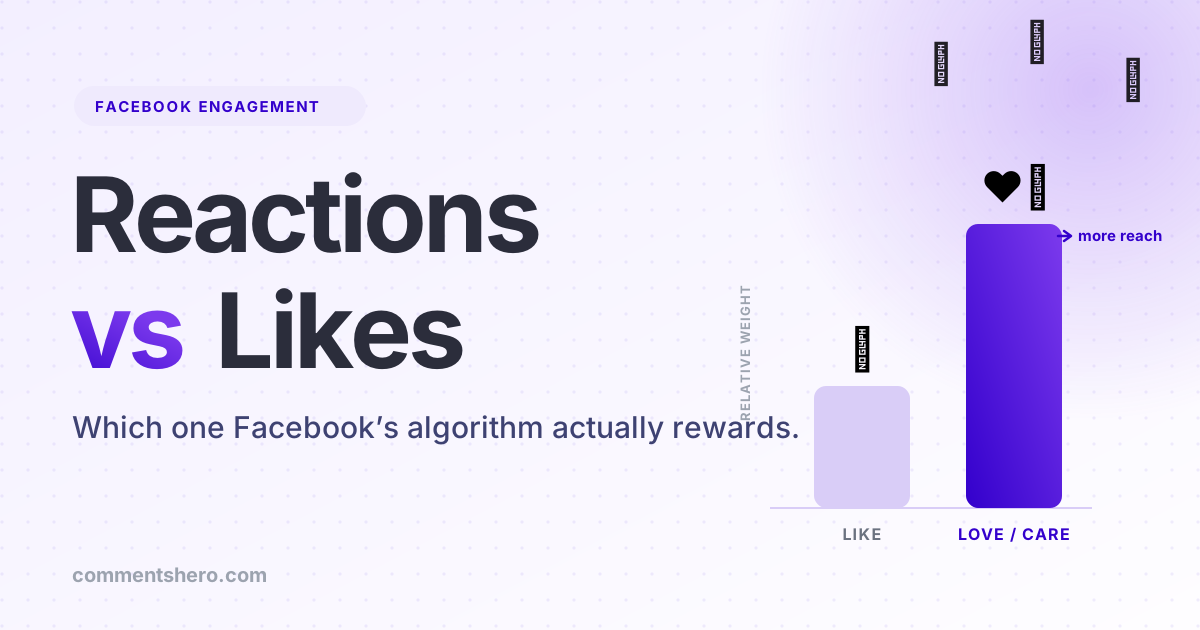
Every reaction order is delivered to the public post URL — no password, nothing installed. Reactions come from real, active profiles and are spread over hours so the post’s engagement curve looks like natural discovery. If any drop off within 30 days, they’re refilled. On larger orders we recommend adding a few comments so the mix stays believable. That’s the whole model, and it’s the same reasoning as how reactions feed reach in the first place.
Safer still: earn some yourself first
A bought seed works best on top of a post that isn’t starting from nothing. Write the first line for a feeling, add one reaction prompt, publish when your audience is active, and reply fast — the full method is in how to get more reactions on Facebook posts. Then, if the post deserves reach and the first hour is quiet, a small drip closes the gap without looking like anything unusual.
Frequently Asked Questions
Is it against Facebook’s rules to buy reactions?
Facebook’s policies target inauthentic behaviour — fake accounts, bots, coordinated spam. Reactions from real profiles delivered at a natural pace don’t match that pattern, which is why the delivery method matters far more than the purchase itself.
Can buying reactions get my Page banned?
Not when they come from real accounts, arrive gradually, and you never share login details. Bans usually trace back to bot services or handing account access to an untrustworthy seller — not to the reactions themselves.
Do I have to give my password?
No, and you should never work with anyone who asks. Legitimate reaction delivery only needs the public URL of the post. A password request is an account-takeover risk on its own.
Will the reactions disappear?
Real-profile reactions are stable. Bot reactions get removed in spam sweeps. A refill guarantee (we offer 30 days) covers the small amount of natural drop-off that can happen with any engagement.
How many reactions is “safe” to buy?
Scale it to your Page. On a small Page, 20–75 changes how a post reads without standing out; on a larger Page, 100–250. The goal is “this caught on,” and the ratio to comments should stay believable.
Is buying reactions safer than buying likes?
The safety rules are identical — real accounts, drip delivery, no password. Reactions just tend to do more for reach per unit, so you need fewer of them to get the same effect.